Eaton 5PX1500IRT UPS: replacing the stock fans with quiet 80 mm fans
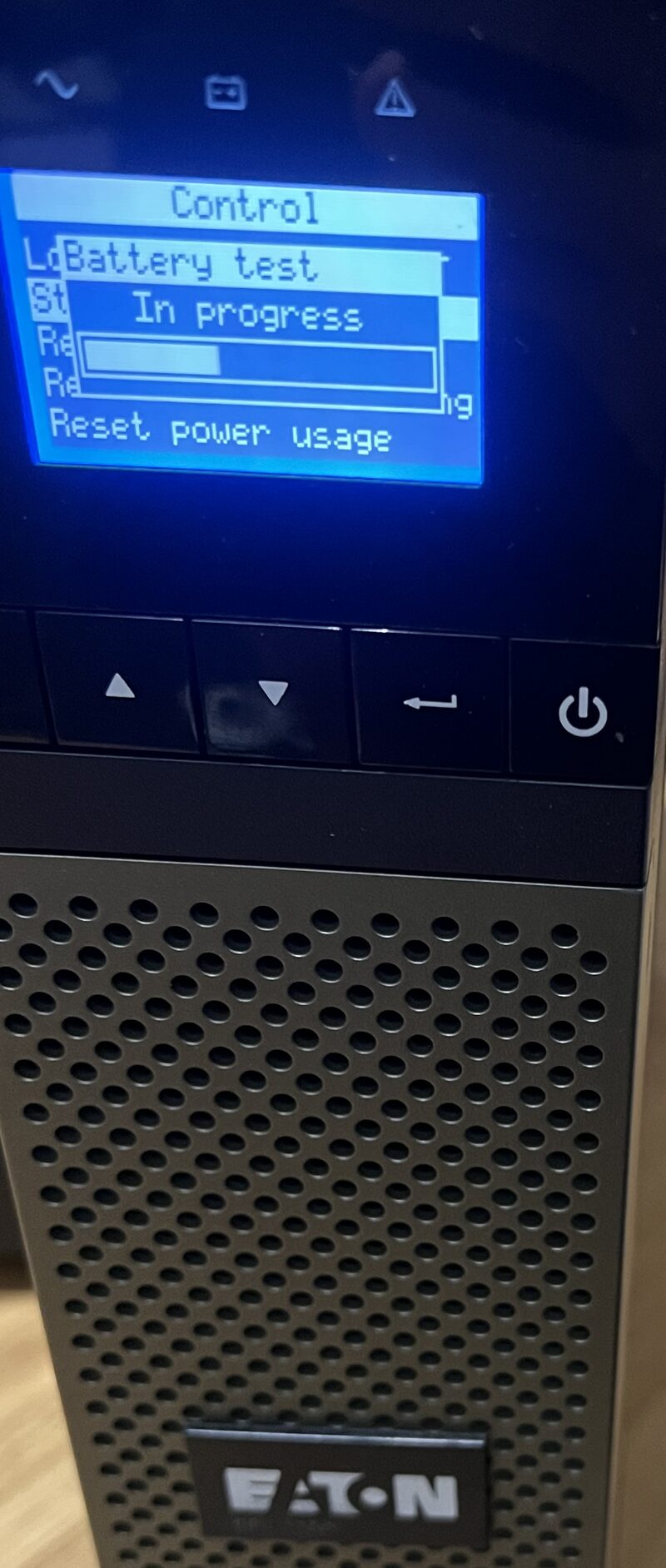
I bought a refurbished Eaton 5PX1500IRT UPS with new batteries for about $189. I also bought a larger APC SRT3000 for my server rack. What sold me on the Eaton was its shape. It’s a 2U rack UPS that can stand upright beside my desk, where it keeps my workstation, monitors, GPU machine, NAS and network gear running through power cuts.
Then I switched it on. In my office it sounded like a jet engine starting up, all day.
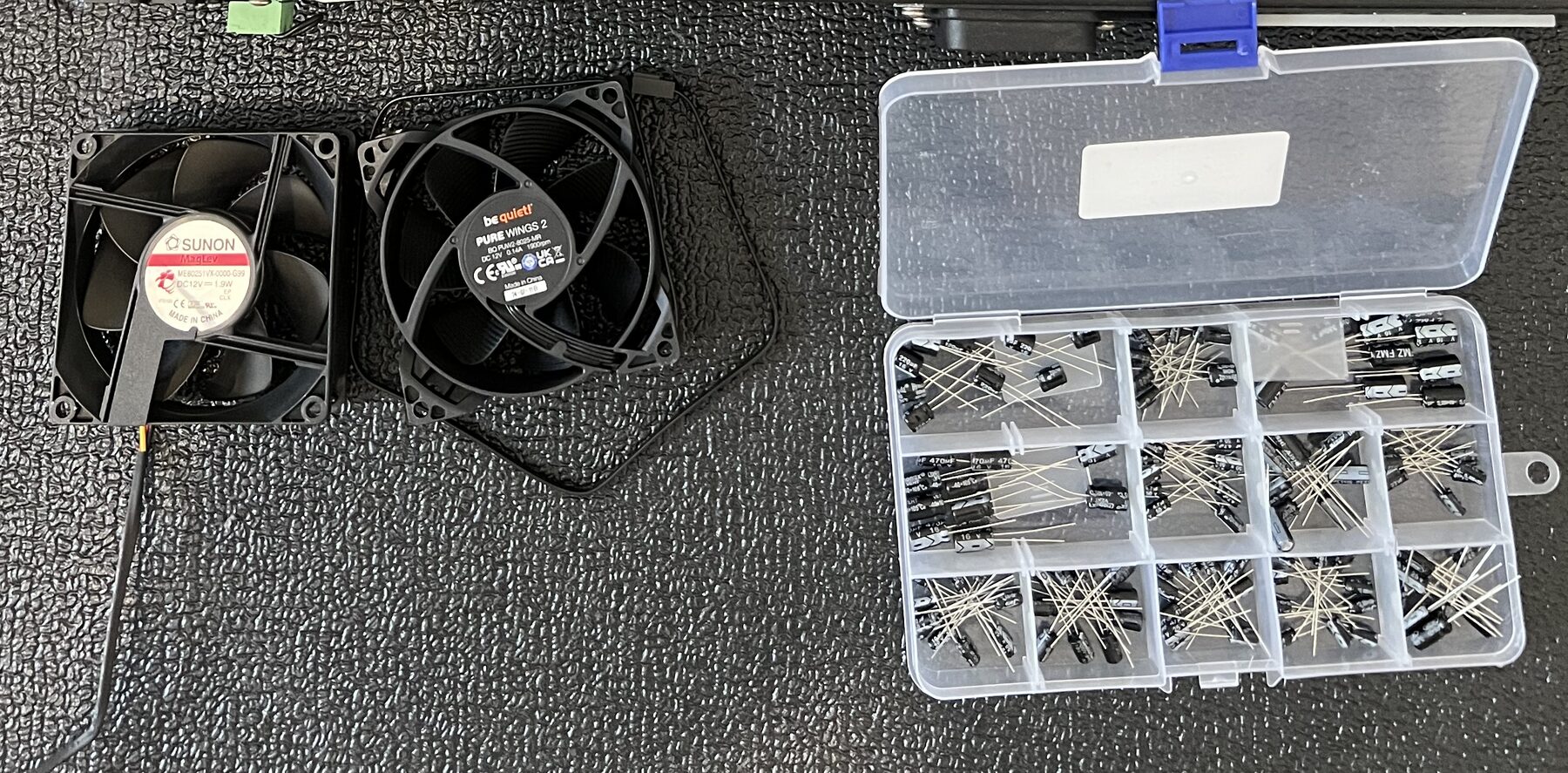
I spent $17 on a pair of be quiet! Pure Wings 2 fans. The awkward part was the wiring. Eaton had glued both fan plugs to the board, and the new fans used a different plug with two wires in different positions.
Stock fans
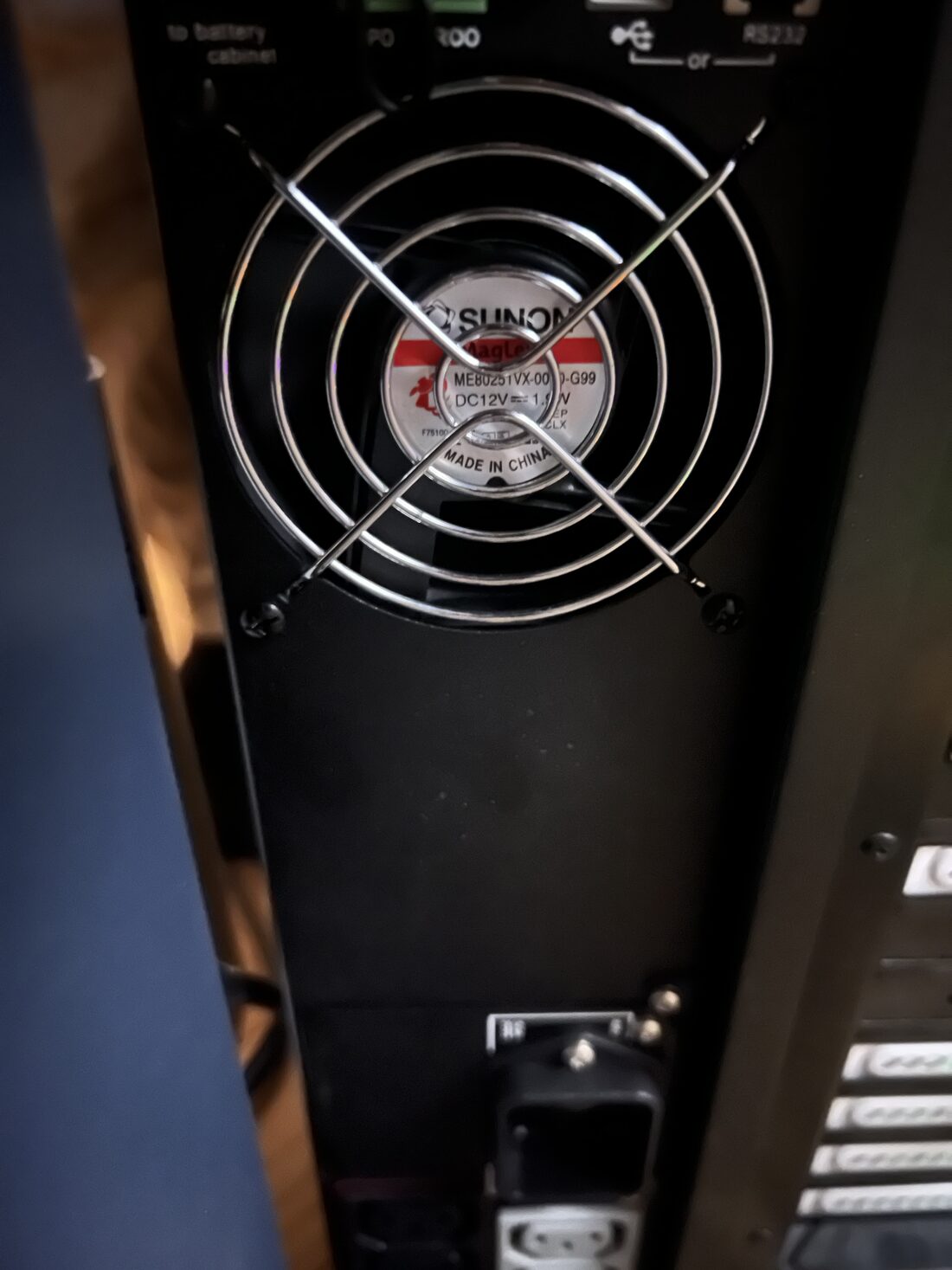
My unit had two 80 mm Sunon MagLev fans (ME80251VX-0000-G99), one behind the front bezel and one on the back panel. Each is rated for 3600 RPM and 37 dB(A). They have three wires for power, ground and speed feedback. There’s no separate PWM input. I didn’t measure their speed.11Sunon’s catalogue gives the ratings for the ME80251VX.
The UPS is rated for 1500 VA and 1350 W. Mine usually shows 20–40% load on the LCD. That was why I was willing to try a slower fan. I also wanted one that could draw air through the perforated bezel and past the transformer and heatsinks.
Reading the fan specs
The airflow rating tells you how much air a fan moves in free air. The maximum static pressure tells you how much pressure it can develop with the outlet blocked, when airflow falls to zero. Inside the UPS the fan operates somewhere between those points. The front and rear fans move air through the same case, so adding their free-air ratings won’t tell you how much air passes through it.
The candidates
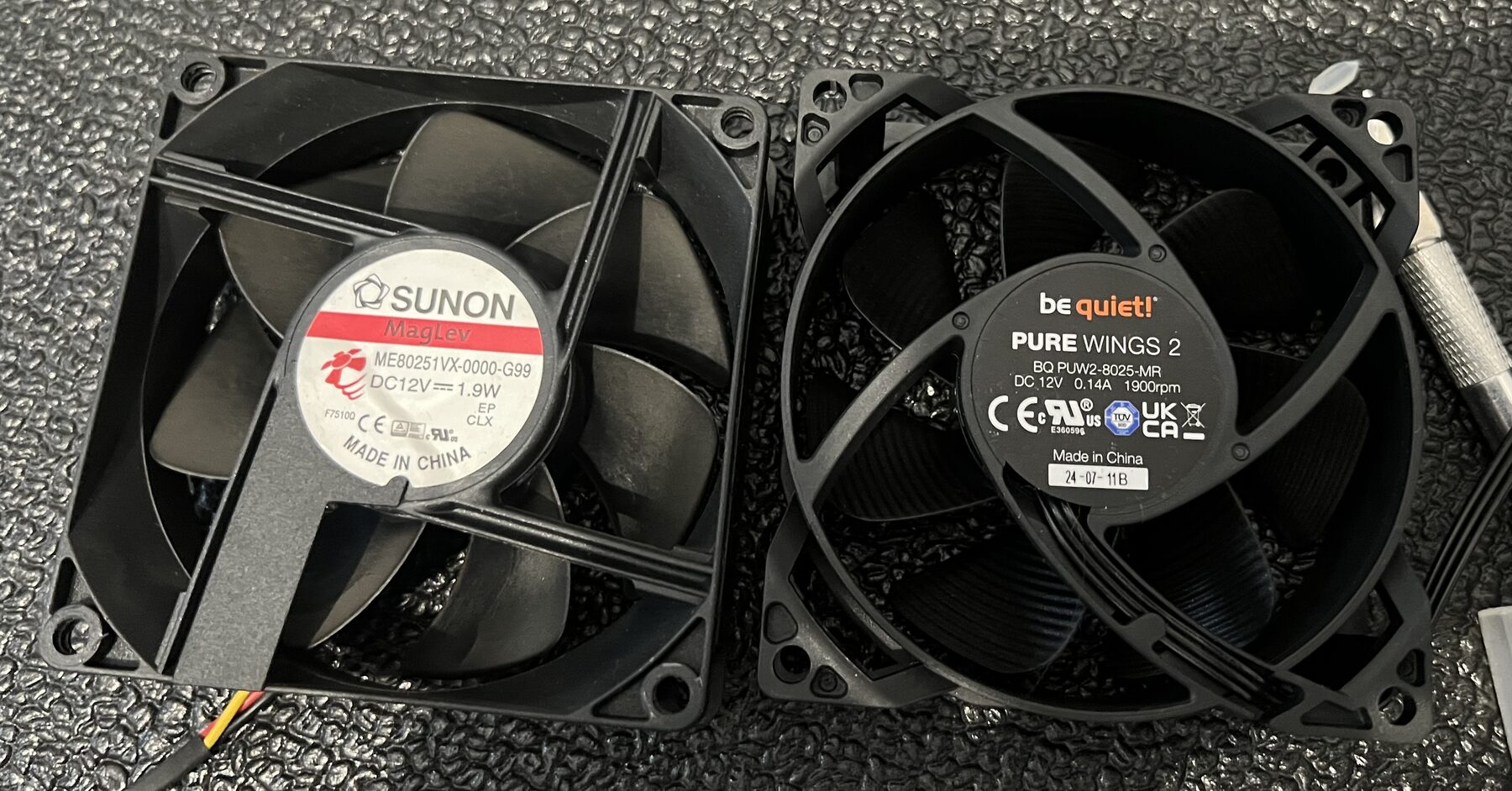
I wanted a fan I could get quickly. Several models were out of stock, and the cheaper ones on AliExpress would have taken weeks. The Pure Wings 2 was available, had published specs and cost $8.60 each. Its maximum static pressure was close to the Noctua NF-A8 FLX’s at less than half the price.
I put this comparison together after the swap. All the fans are 80 × 80 × 25 mm and run on 12 V.
| Fan | RPM | Free-air flow, m³/h | Max. pressure, mmH₂O | Noise | Price each |
|---|---|---|---|---|---|
| Sunon ME80251VX (stock) | 3600 | 76.5 | 5.84 | 37 dB(A) | $4–12 |
| be quiet! Pure Wings 2 80 (bought) | 1900 | 44.5 | 1.85 | 18.2 dB(A) | $8.60 |
| Noctua NF-A8 FLX | 2000 | 50.4 | 1.96 | 16.1 dB(A) | $20 |
| Noctua NF-R8 redux-1800 | 1800 | 53.3 | 1.41 | 17.1 dB(A) | $14 |
| Arctic F8 | 2000 | 52.7 | 1.0 | ≈26 dB at 1 kHz (from 0.3 sone) | $5 |
| Arctic P8 | 3000 | 39.8 | 1.90 | ≈26 dB at 1 kHz (from 0.3 sone) | $5 |
| Arctic P8 Max (PWM) | 5000 | 68.0 | 5.3 | ≈33 dB at 1 kHz (from 0.6 sone) | $6.40 |
Prices are approximate, per fan, as of November 2026. The Pure Wings price is what I paid in January. The Sunon range runs from a parts distributor to eBay. Arctic rates its fans in sones. The conversion gives the level of a 1 kHz tone that sounds equally loud. The fan’s actual dB(A) level depends on its frequency spectrum.22Loudness conversion from ISO 532-1. Fan specifications from Noctua (redux), Arctic (F8, P8, P8 Max), and be quiet!.
The swap
I shut down the UPS, unplugged it and removed the battery pack behind the front bezel. Even with mains and battery disconnected, capacitors inside the UPS can hold enough charge to give you an electric shock.33See the installation and user manual under Eaton’s documentation for the 5PX1500IRT.
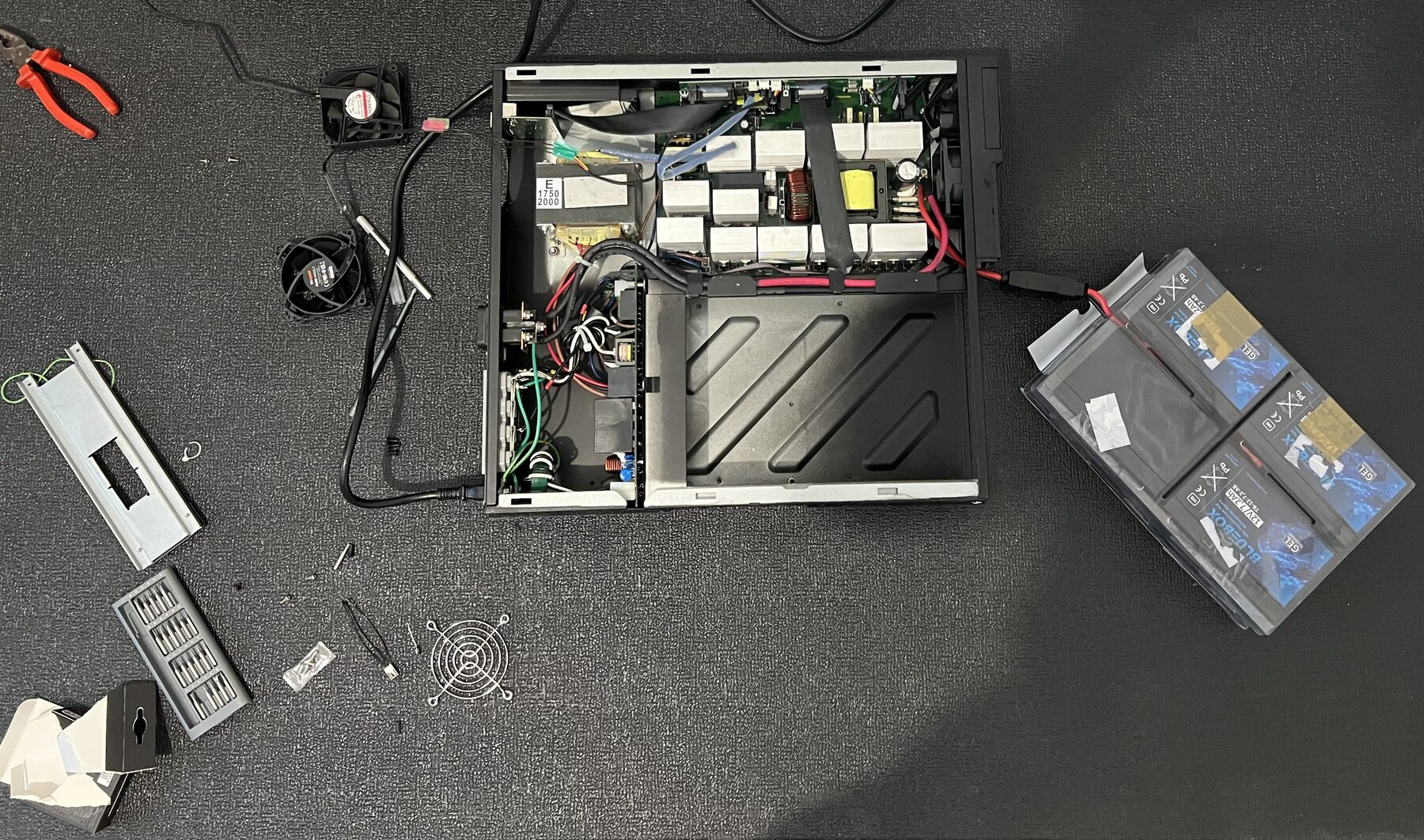
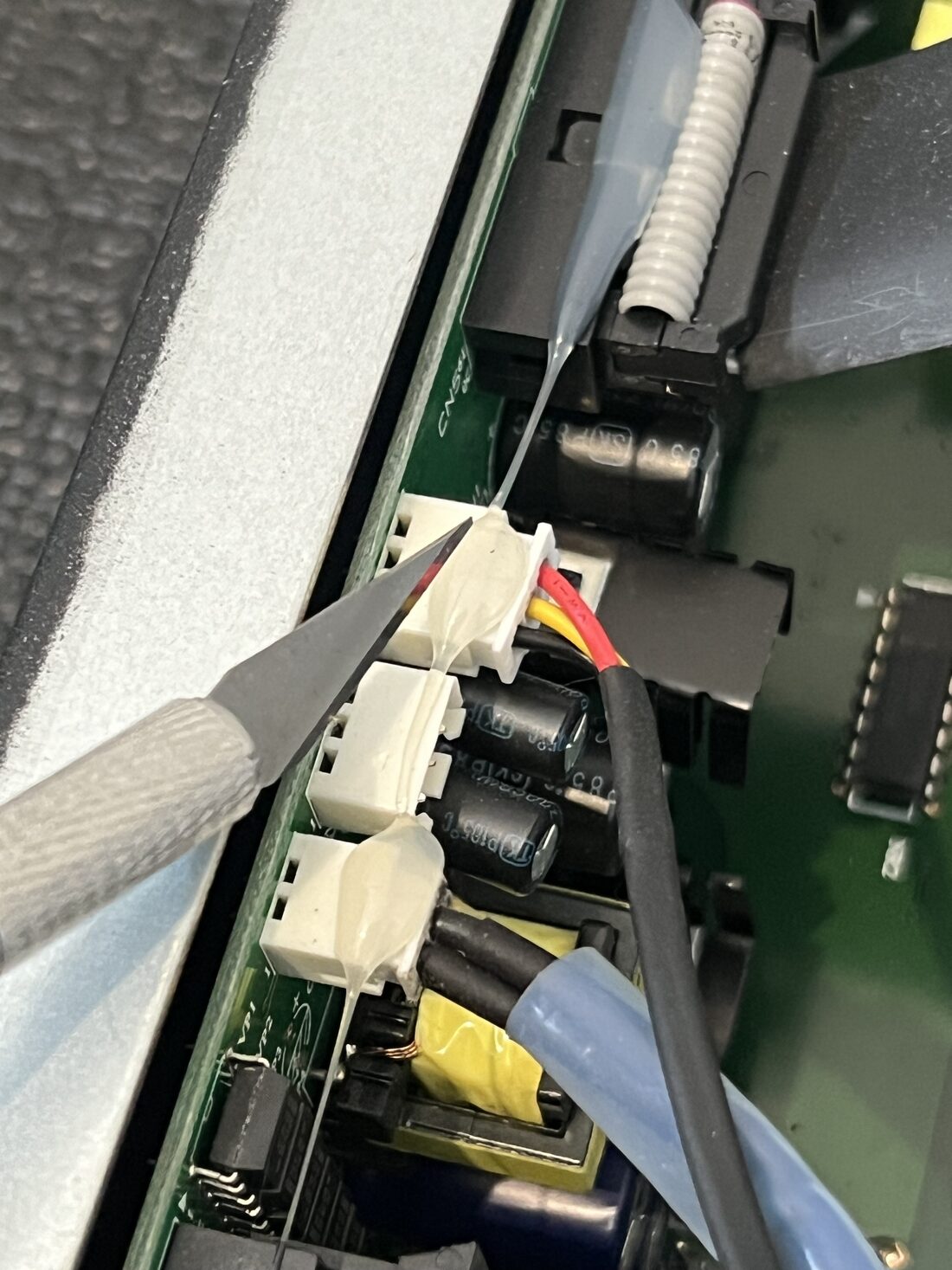
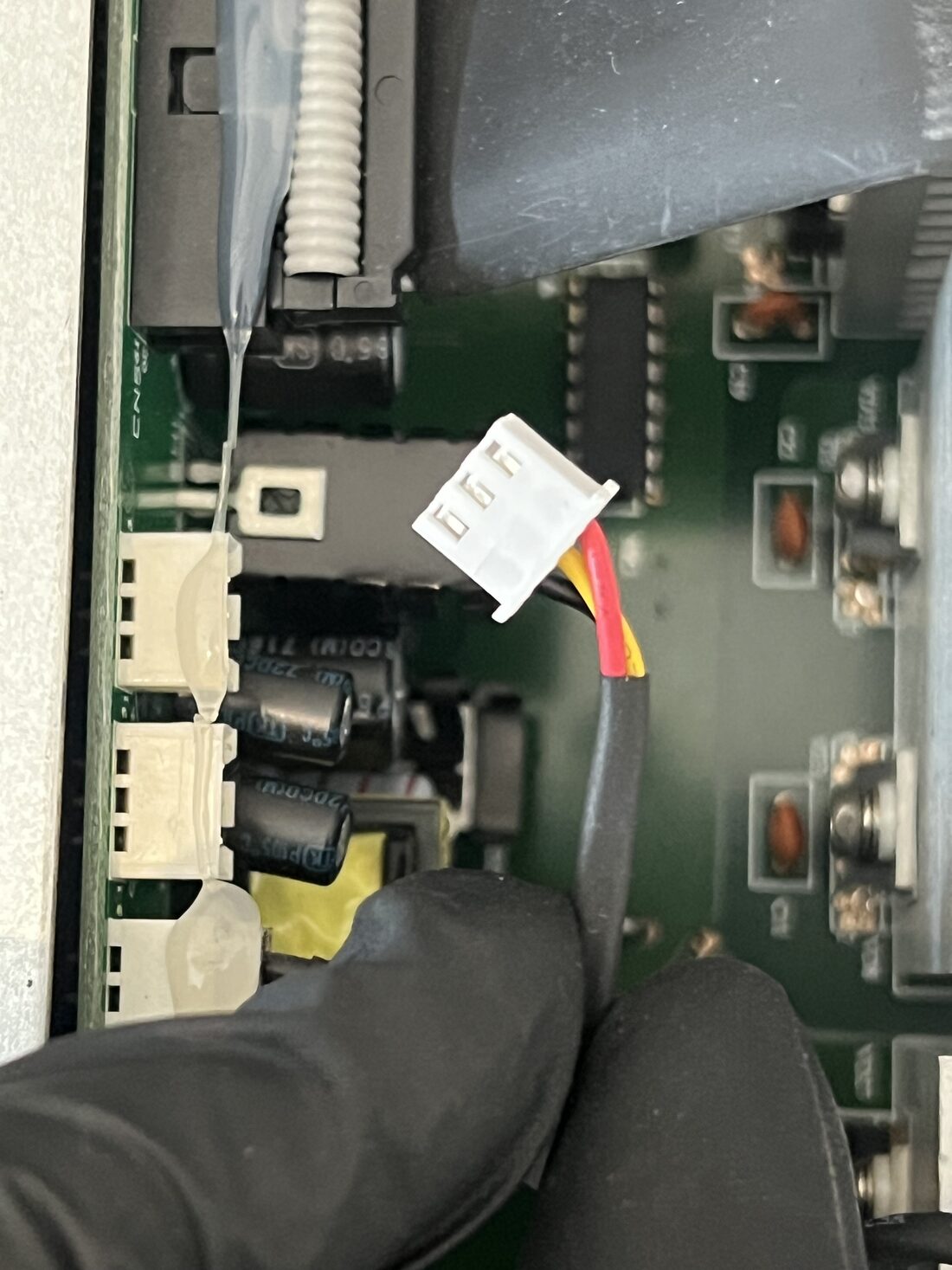
The glue. Each fan plug is fixed to its header on the board with a blob of translucent glue. Pulling on the wires does nothing good. I sliced the blob with a scalpel and the plug lifted out.
The plug. Eaton used a three-pin JST-XH connector. The centre wire on the Eaton plug carries the speed signal. On the PC fan plug the centre wire carries +12 V.44The pinout reported by dvl in the 5PX fan-swap thread matches the wire colours on my Sunon.
I cut each Sunon lead a few centimetres from the white plug so I could reuse it. The Sunon had a red wire for +12 V, black for ground and yellow for the speed signal. The Pure Wings leads were all black, so I identified each one by its position in the original PC plug before splicing the matching leads. I mounted each fan with its airflow arrow pointing the same way as the one it replaced.
Fan-fault alarm
I’d read about a 9PX owner who needed a capacitor on the signal wire, so I put a box of capacitors on the bench. His stock fan reported whether it had stalled. The G99 suffix on my Sunon identifies a fan that sends speed pulses, as the Pure Wings does. My 5PX started without a complaint, and the capacitors went back in the drawer.55Sunon’s model numbering guide identifies G99 as F-type feedback. Florian Bernd describes the different signal on his unit in his 9PX fan swap.
Result
I bought this UPS because it fit beside my desk. Now I can sit there with the workstation idle and I can’t hear the UPS at all.
November 2026, ten months after the swap. The UPS has ridden through several power cuts. The longest I remember was about half an hour. I haven’t measured internal temperatures, so I don’t know how much cooling margin is left. At my usual desk load, I’ve had no fan alarms, temperature alarms or unexpected shutdowns.
A power station instead?
If I were buying today, I’d also look at portable power stations with a UPS mode. EcoFlow makes several. The RIVER 3 UPS is the small one, with 245 Wh and 300 W of output. That covers a router and a NAS, but not my desk, which draws roughly 270–540 W. The DELTA 3 Plus has 1024 Wh and 1800 W, so it could carry the desk. Anker, Bluetti and Jackery sell similar units.66Specifications from EcoFlow’s RIVER 3 and DELTA 3 series pages.
Battery. They use lithium iron phosphate (LFP) cells, which EcoFlow rates for 3000–4000 cycles before capacity drops to 80%. Lead-acid batteries manage a few hundred deep cycles. Cycle counts matter less at a desk, though. The battery sits fully charged and discharges only in a power cut. Lead-acid UPS batteries wear out from age, and usually need replacing every three to five years. LFP should last much longer in the same role.
Switchover. The 5PX switches to battery in 1–4 ms. EcoFlow promises under 10 ms for the RIVER 3 UPS and DELTA 3 Plus, and StorageReview measured just over 8 ms on the DELTA 3 Plus. The plain RIVER 3 and several competing models are rated for 20 ms. During the gap the PC runs on the charge stored in its power supply. ATX 3.1 requires a power supply to hold up for only 12 ms at full load, so 10 ms leaves a small margin and 20 ms may not be enough.77Transfer times from the 5PX spec sheet and StorageReview’s DELTA 3 Plus review. LTT Labs explains the ATX hold-up requirements.
Shutdown. The Eaton reports to the computer over standard USB HID, which NUT and Windows both recognise. Among EcoFlow’s models, the DELTA 3 Plus and RIVER 3 Plus can signal a shutdown, but a firmware bug stops Windows’ built-in UPS support from reading them. One owner wrote a NUT-based workaround.
Noise. EcoFlow quotes 30 dB below 600 W. T3’s reviewer found the DELTA 3 Plus fans cycling on about once a minute even at low load. After everything above, I’d want to hear that one before putting it on my desk.88T3’s DELTA 3 Plus review.
A power station also works off-grid and can charge from solar. The Eaton fits a rack, takes a network card, and costs little refurbished. Which one makes more sense depends on what you need. If the computers must shut down cleanly on their own, the Eaton is simpler. If you want long runtime, portability and fewer battery replacements, a power station is worth a look.