Guessing TIME’s Person of the Year 2025 from cover filename
Spoiler: it didn’t work. The cover leaked anyway, from a filename I never guessed.
Prediction markets are supposed to aggregate beliefs. Late in 2025 they started to look like a bounty program for anything that existed before the announcement.
First came the Nobel Peace Prize. Hours before the official announcement, María Corina Machado’s Polymarket odds moved from 3.75% to nearly 73%. No expert or media outlet had treated her as a favorite. The Norwegian Nobel Institute later told Norwegian media a leak was “highly likely” espionage.11CBS/AFP, Possible Nobel Peace Prize leak was “highly likely” espionage. The original market was Nobel Peace Prize Winner 2025. That looked less like forecasting than like somebody learning a settled fact early.
Then came Spotify Wrapped. A market on a wonderfully narrow question — whether The Weeknd or Drake would finish third among the year’s global artists — moved to 99% for The Weeknd before Spotify published the list. Spotify’s final page did put The Weeknd third and Drake fourth. Reporting afterward said traders believed the rankings had been found in a publicly accessible WordPress-backed newsroom file linked to a staging API. The reporter could verify the ranking and the market move, but not the exact file.22DeFi Rate, Polymarket Traders Knew The Weeknd Was Going to Beat Drake on Spotify Wrapped. Spotify’s published rankings are here: The Top Artists, Songs, Albums, Podcasts, and Audiobooks of 2025. The interesting claim was not “the crowd was wise.” It was “someone found the publishing plumbing.”
That was enough of a pattern to make the next target obvious. TIME was about to name its 2025 Person of the Year. Polymarket had been taking bets on the winner since June.33TIME 2025 Person of the Year, opened June 26, 2025.
1. The CMS publishing surface
A magazine also has to do something the Nobel Committee does not: build the story inside a CMS. I spent the next day on TIME’s WordPress install, its sitemap XML, and the plugins I could identify.
The useful part is how WordPress keeps a story before it goes live. A post is a row in the database with a status: draft, private, or future for a scheduled one. Every request for the post’s URL goes through WordPress, which reads that status and returns a 404 to anyone who is not logged in. The post stays out of the sitemap, the RSS feed and the public API until someone presses publish or the clock reaches the scheduled hour.
Images do not work that way. The moment an editor drags a picture into the draft, WordPress writes it to disk under /wp-content/uploads/, in a folder named after the current year and month, under the name the file was uploaded with. It also writes resized copies next to it. From then on the web server or CDN serves those files like any other static file. WordPress never runs for that request, so nothing asks whether the post using the image is published. The draft is private; its pictures are public to anyone who asks for the right URL.
So if the post is waiting for a publish button or a scheduled hour, the pictures may already be sitting on the server. The year and month are given by the calendar. The only thing left to guess is the filename.
So I treated the announcement like a small recon problem. Not “who will TIME choose?” but “what public artifact would have to exist before TIME tells everyone?”
2. Candidate inventory from Polymarket
The Polymarket market was useful before I ever touched TIME’s website. It had already done the candidate collection.
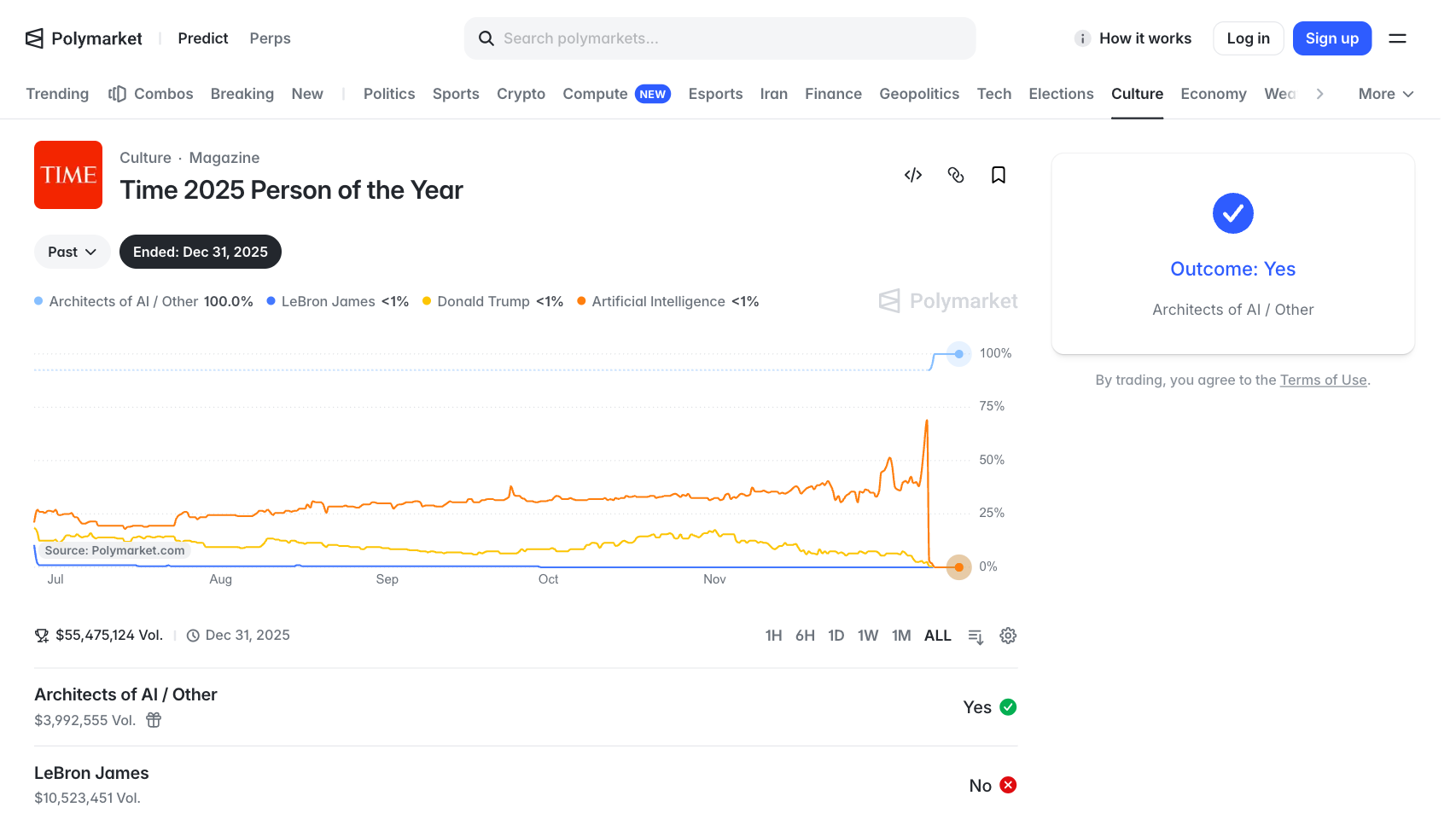
I started on December 5.44The date of the first commit in the research repository. Prices are the last hourly point before 14:23 UTC that day, from Polymarket’s public price history. That afternoon the market looked like this:
| Option | Dec 5 price |
|---|---|
| Artificial Intelligence | 37¢ |
| Jensen Huang | 29.5¢ |
| Sam Altman | 8.5¢ |
| Pope Leo XIV | 7.5¢ |
| Donald Trump | 6.5¢ |
| Benjamin Netanyahu | 2.9¢ |
| Xi Jinping | 2.6¢ |
| Zohran Mamdani | 2.4¢ |
| Charlie Kirk | 2.4¢ |
| Elon Musk | 1.6¢ |
| Jerome Powell | 0.9¢ |
| Volodymyr Zelenskyy | 0.5¢ |
| Taylor Swift | 0.4¢ |
| LeBron James | 0.15¢ |
| Pope Francis | 0.1¢ |
The option that eventually won, later labelled “Architects of AI / Other”, has no price history before December 11. Nobody was trading the right answer by name.
That table was the whole input for the next steps: fifteen names, ordered by how seriously the crowd took them.
3. Initial index reconnaissance
I started with the obvious public indexes. TIME’s day-level sitemap for December 10 had nothing useful. The cover archive was exposed through a GraphQL endpoint, so I asked for 2025 covers too:
curl 'https://api.time.com/graphql' \
  -H 'content-type: application/json' \
  --data-raw '{"operationName":"Covers","variables":{"year":2025},"query":"query Covers($year: Int) { covers(coverYear: $year) { magazineData } }"}' \
| jq -r '.data.covers.magazineData | fromjson | .[] | { title, url: ("https://time.com" + .path) }'
The interesting part of that result was what was missing. No Person of the Year cover.
That pushed me from indexes to assets. The 2024 Person of the Year story had a file with a name that was almost too helpful:
time-person-of-year-trump-cover-choice-mobile.jpg
That filename contains the winner, the package, the editorial role of the image, and the target surface. A file named donald-trump-plane.jpg would not mean much; TIME publishes plenty of photos of Trump. A file named trump-cover-choice-mobile.jpg in December means something different.
The file lived under /wp-content/uploads/, the folder from section 1. To check that the draft-versus-upload gap was real and not just how I read the docs, I set up WordPress locally with the same class of plugins I could identify on TIME: create a draft, upload an image, keep the post private, request the image URL directly. The image loaded.
That test did not prove TIME’s production setup behaved the same way. It made the hypothesis concrete enough to test: if the cover had already been uploaded, and if the filename followed an old habit, a direct URL might answer before the article did.
4. Mask derivation from historical cover filenames
I scraped TIME’s Person of the Year pages and extracted image URLs. Older years mostly led to TIME’s Vault, so the useful web sample was small: 80 image URLs from six award years.
| Award year | Saved image URLs |
|---|---|
| 2015 | 12 |
| 2016 | 9 |
| 2021 | 19 |
| 2022 | 6 |
| 2023 | 16 |
| 2024 | 18 |
| Total | 80 |
The sample was noisy. Many images in a Person of the Year article are not covers: rallies, planes, family photos, recirculation cards, buttons, headers. That noise was useful because it kept the method honest. I was not training on a clean list of “the exact kind of file I want.” I was learning what TIME actually published around these packages.
Taylor Swift’s 2023 package showed one family of names clearly:
import csv
from pathlib import Path
from urllib.parse import urlsplit

with open("001_times_articles/times_person_of_the_year_images.csv") as images:
    for row in csv.DictReader(images):
        name = Path(urlsplit(row["image_url"]).path).name
        if row["year"] == "2023" and name.startswith("SWIFT.FINAL"):
            print(name)
SWIFT.FINAL_.COVER3_.jpg
SWIFT.FINAL_.COVER2_.jpg
SWIFT.FINAL_.COVER1_.jpg
Those stray underscores repeated, so I treated them as signal, not typo.55They are WordPress’s doing. On upload it appends _ to any dot-separated piece of a filename that looks like an extension it does not allow, a guard against names like shell.php.jpg. A designer’s SWIFT.FINAL.COVER3.jpg becomes SWIFT.FINAL_.COVER3_.jpg, and FINAL.GRID.jpg becomes FINAL.GRID_.jpg. The mental model was password cracking: keep the stable parts, vary the candidate name, number, folder, and extension.
Each pattern family gives one mask. The middle column is a real file that mask would have matched:
| Pattern family | Example from history | Candidate shape |
|---|---|---|
| Full slug | time-person-of-year-2024-donald-trump.jpg | time-person-of-year-{year}-{name}{suffix}.{ext} |
| “The” variant | time-person-of-the-year-2022-volodymyr-zelensky.jpg | time-person-of-the-year-{year}-{name}{suffix}.{ext} |
| Last name only | time-person-of-year-trump-cover-choice-mobile.jpg | time-person-of-year-{last}-cover-choice-mobile.{ext} |
| Editorial code | TIM221226.POY-Final-Cover.jpg | TIM{YY}12{DD}.POY-Final-Cover.{ext} |
| Uppercase cover | SWIFT.FINAL_.COVER1_.jpg | {LAST}.FINAL_.COVER{n}_.{ext} |
| Generic | cover-final.jpg | cover-final.{ext} |
Here is the mechanical step. A candidate is lowercased, split into pieces, turned into a slug, then dropped into each mask. Aliases matter: Pope Leo XIV produces different guesses from Pope Leo, Leo XIV, or Robert Prevost.
I tested the masks against the files I already had. They matched every year at least once, but only 25 of 72 test URLs overall. That number is a warning label. The generator was good enough to rediscover historical cover-ish files; it was nowhere near a complete model of TIME’s image naming.
PATTERN COVERAGE TEST
  2024 Donald Trump      2/18  (11.1%)
  2023 Taylor Swift      8/16  (50.0%)
  2022 Volodymyr Zelenskyy 1/6 (16.7%)
  2021 Elon Musk         7/19  (36.8%)
  2016 Donald Trump      1/5   (20.0%)
  2015 Angela Merkel     6/8   (75.0%)

SUMMARY
  URLs matched: 25/72 (34.7%)
  Years matched: 6/6
The obvious failure mode was not subtle: the real file could be named by an editor, designer, CMS plugin, export script, image cropper, or social team whose habits did not appear in six years of examples.
5. Candidate generation and URL enumeration
The mask only gives structure. It still needs names.
For that, Polymarket was convenient. I took its visible candidates and added aliases a filename might use: Sam Altman and Samuel Altman, Pope Leo XIV, Pope Leo, Leo XIV, and Robert Prevost, Jerome Powell and Jay Powell, Volodymyr Zelenskyy and Volodymyr Zelensky, Benjamin Netanyahu and Bibi Netanyahu. I also added the abstract candidates because prediction markets had entries like AI.
uv run python 002_generate_patterns/generate_image_urls.py \
  --year 2025 \
  --prefix '' \
  --names \
    "ai" "artificial intelligence" \
    "Jensen Huang" \
    "Sam Altman" "Samuel Altman" \
    "Pope Leo XIV" "Pope Leo" "Leo XIV" "Robert Prevost" \
    "Donald Trump" \
    "Zohran Mamdani" \
    "Benjamin Netanyahu" "Bibi Netanyahu" \
    "Charlie Kirk" \
    "Jerome Powell" "Jay Powell" \
    "Xi Jinping" \
    "Volodymyr Zelenskyy" "Volodymyr Zelensky" \
    "Elon Musk" \
    "Pope Francis" "Jorge Bergoglio" \
    "Taylor Swift" \
    "LeBron James" \
  > all_candidates.txt
The generator varied seven likely upload folders, three extensions, numeric suffixes, uppercase forms, POY forms, issue-code forms, and generic cover names. My first tiny run — only ai — already produced 11,781 paths. One broader run shown in my terminal screenshot had 181,083 guesses; the saved wordlist I kept after a later cleanup has 176,235.
The result is a plain list of paths. One line is one guess. The order is not a priority ranking: the generator de-duplicates with list(set(...)), so head and tail show the shape of the list rather than the best candidates.
$ wc -l all_candidates.txt
176235 all_candidates.txt

$ head -n 20 all_candidates.txt
/2022/12/1-time-person-of-the-year-ai-01.jpeg
/2022/12/1-time-person-of-the-year-ai-01.jpg
/2022/12/1-time-person-of-the-year-ai-01.png
/2022/12/1-time-person-of-the-year-ai-02.jpeg
/2022/12/1-time-person-of-the-year-ai-02.jpg
/2022/12/1-time-person-of-the-year-ai-02.png
/2022/12/1-time-person-of-the-year-ai-03.jpeg
/2022/12/1-time-person-of-the-year-ai-03.jpg
/2022/12/1-time-person-of-the-year-ai-03.png
/2022/12/1-time-person-of-the-year-ai-04.jpeg
/2022/12/1-time-person-of-the-year-ai-04.jpg
/2022/12/1-time-person-of-the-year-ai-04.png
/2022/12/1-time-person-of-the-year-ai-05.jpeg
/2022/12/1-time-person-of-the-year-ai-05.jpg
/2022/12/1-time-person-of-the-year-ai-05.png
/2022/12/1-time-person-of-the-year-ai-1.jpeg
/2022/12/1-time-person-of-the-year-ai-1.jpg
/2022/12/1-time-person-of-the-year-ai-1.png
/2022/12/1-time-person-of-the-year-ai-2.jpeg
/2022/12/1-time-person-of-the-year-ai-2.jpg
Those paths are relative to https://api.time.com/wp-content/uploads/. ffuf swaps the literal FUZZ for each line, so the first request above becomes https://api.time.com/wp-content/uploads/2022/12/1-time-person-of-the-year-ai-01.jpeg. A real cover would appear as a 200; everything else should be a 404.
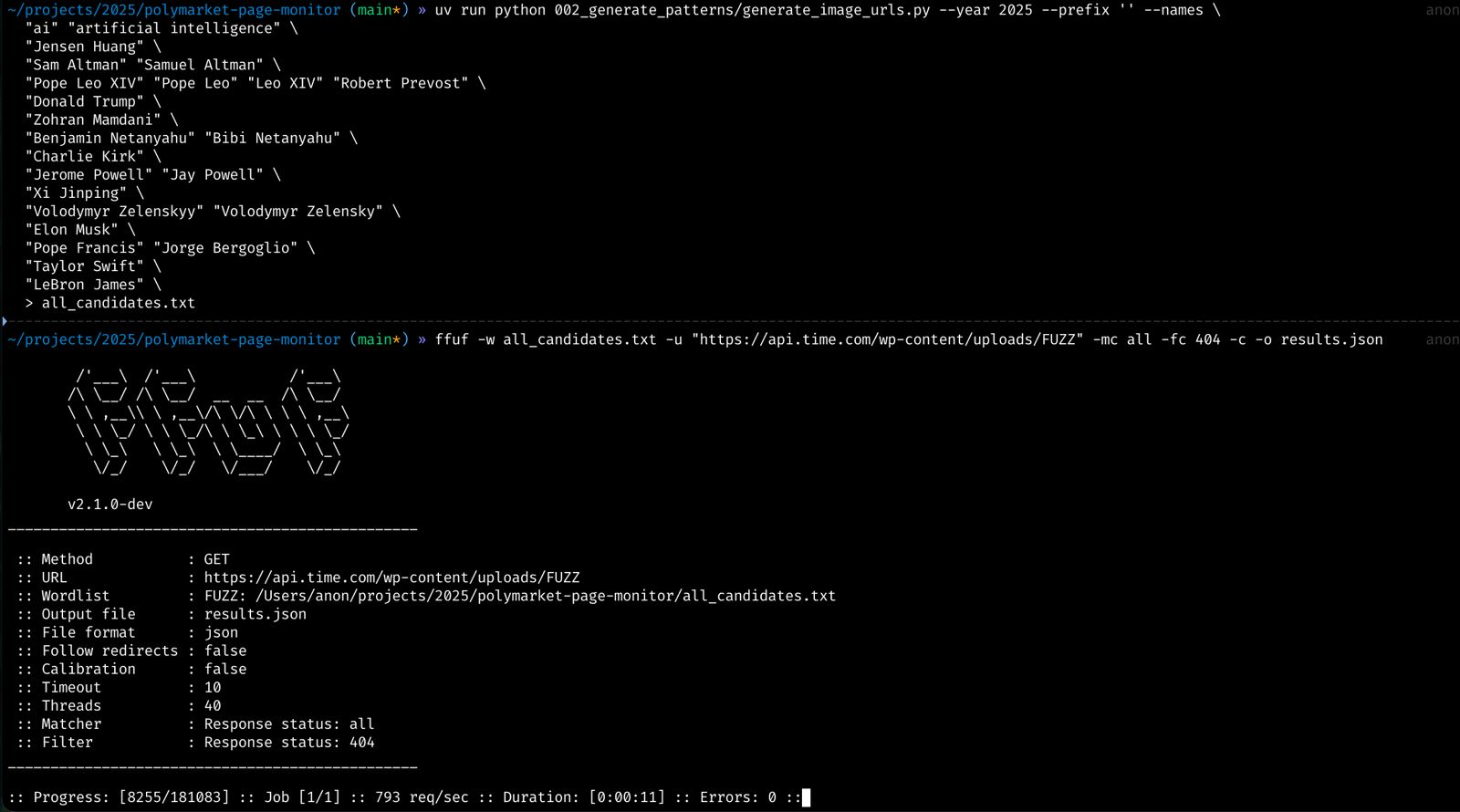
The probing command was standard ffuf, with missing files filtered out:
ffuf -w all_candidates.txt \
  -u "https://api.time.com/wp-content/uploads/FUZZ" \
  -mc all \
  -fc 404,429 \
  -t 20 \
  -H "user-agent: Mozilla/5.0" \
  -o results.json \
  -of json
The last saved run did not find a cover.
{
  "time": "2025-12-11T08:56:31+01:00",
  "results": []
}
That empty array had three interpretations, and I could not distinguish them from the run alone:
- The cover had not been uploaded to the reachable path yet.
- The cover was uploaded, but the filename was outside my masks.
- TIME’s production path or access controls did not behave like my local WordPress test.
The only honest result was negative: no guessed URL returned a useful hit.
6. Failed retrieval and the reported leak
The cover did leak before the announcement. Someone found it on TIME’s server, under a filename my wordlist did not contain.
Polymarket had opened a second market on December 9: Will TIME 2025 Person of the Year be leaked? It resolved Yes if any option in the main market traded above 90¢ for most of an hour, at least four hours before the official reveal. I did not use it during the search. Afterwards it was the clearest record of when the answer got out.
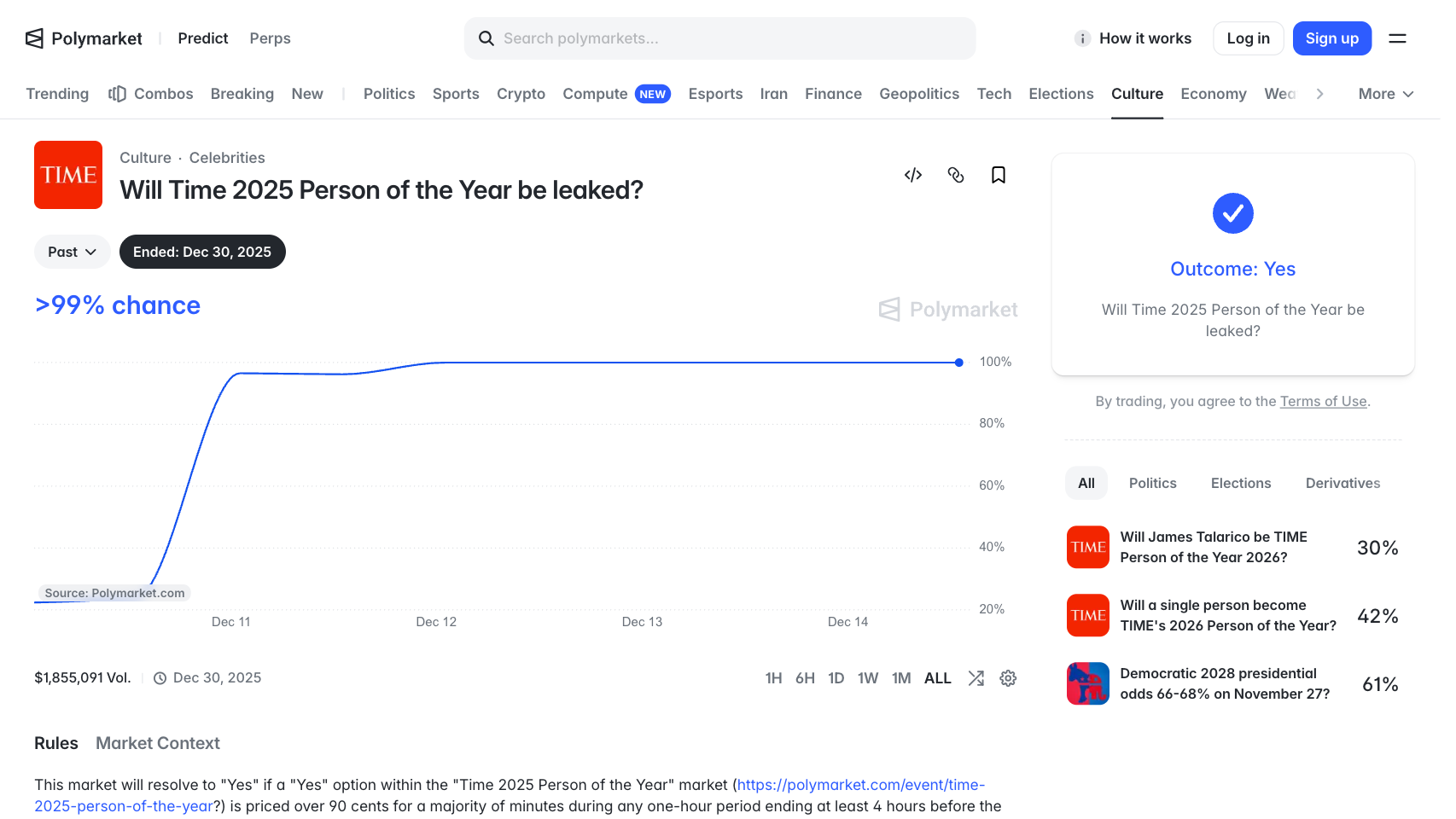
Its public price history is sampled too coarsely to prove the exact one-hour rule, but the shape is plain:
| UTC sample | Leak-market Yes price |
|---|---|
| Dec 10 00:00 | 22.5¢ |
| Dec 10 12:00 | 24.0¢ |
| Dec 11 00:00 | 96.4¢ |
| Dec 11 12:00 | 96.2¢ |
| Dec 12 00:00 | 99.95¢ |
On Wednesday evening, before TIME’s Thursday announcement, Polymarket posted that the Person of the Year had reportedly leaked, with cover imagery attached. TechCrunch later wrote that TIME’s cover photos had leaked on Polymarket the evening before the official announcement.66TechCrunch, TIME names ‘Architects of AI’ its Person of the Year. ABC/Reuters also described the announcement as confirming rumors after the covers leaked: TIME magazine names ‘The Architects of AI’ as 2025 Person of the Year.
The reported URL is the best punchline: https://time.com/wp-content/uploads/2025/12/FINAL.GRID_.jpg.77Manifold’s Above the Fold post, Peak TIME POTY Drama, called it a “seemingly legit url” and described the cover as probably leaked. Hindustan Times reported an AZ Intel post saying the cover was found on TIME’s web server. I could not verify the image contents after the fact, so I treat the exact leak path as reported, not independently confirmed. No candidate name. No ai. No jensen-huang. Just a generic production filename.
TIME named the Architects of AI as its 2025 Person of the Year. The group included Jensen Huang, Elon Musk, Sam Altman, Mark Zuckerberg, Lisa Su, Dario Amodei, Demis Hassabis, and Fei-Fei Li.88Reuters’ short version: Architects of AI named TIME’s Person of the Year. TIME’s own explainer is How We Chose, though TIME sometimes returns 406 to simple fetchers.
The main market ended with about $55.5M traded across the event, most of it on names that lost:
| Option | Final outcome | Volume |
|---|---|---|
| LeBron James | No | $10.5M |
| Donald Trump | No | $8.1M |
| Artificial Intelligence | No | $7.0M |
| Architects of AI / Other | Yes | $4.0M |
| Pope Leo XIV | No | $3.7M |
| Benjamin Netanyahu | No | $3.5M |
| Jensen Huang | No | $2.7M |
| Sam Altman | No | $2.2M |
7. Post-hoc evaluation of generator coverage
After the announcement I asked a simpler question: could anyone have guessed the cover’s URL in advance? My first answer was no. That was wrong, because TIME kept the cover in two different places, and only one of them can be guessed.
| Surface | Example | What is guessable |
|---|---|---|
| Reported leak | time.com/wp-content/uploads/2025/12/FINAL.GRID_.jpg | Folder and generic export name |
| Published cover 1 | static.time.com/v3/assets/{stack}/{asset UID}/{file UID}/time-magazine-person-of-the-year-ai-2025-001.jpg | Filename only |
| Published cover 2 | Same shape, ending ...-002.jpg with different UIDs | Filename only |
The Contentstack path is the hard one. The stack key is reusable and visible in every asset URL; the unguessable parts are the asset UID and the file UID. Together they are roughly 224 bits of identifier before the readable filename. No candidate mask reaches that by enumeration. That rests on two assumptions I did not test: that Contentstack generates these UIDs randomly, and that they do not show up anywhere else first, such as an API response, a preview link or a log.
The WordPress path is the opposite. The folder is predictable and FINAL.GRID_ is a production export name, not a candidate name. Manifold’s writeup called the URL “seemingly legit,” and a Telegram post preserved by tgregister recorded the same file on December 10. That URL was findable by a generic dictionary if the dictionary contained FINAL.GRID_.
Mine did not:
| Search term | Matches in generated wordlist |
|---|---|
FINAL.GRID | 0 |
GRID | 0 |
cover-final | 63 |
I had generic masks such as cover-final, poy-cover-final, and thechoice. I did not have the designer’s export convention.
I also could not verify that the published Contentstack filename was mirrored under WordPress. The live article references only static.time.com assets; time.com now returns 406 to these requests, and api.time.com returned 404 for the old uploads path in my checks. “Uploaded to both places” remains plausible, but unproven.
So the corrected post-mortem is:
- Candidate masks were the wrong tool for the actual leak.
- A generic filename wordlist containing
FINAL.GRID_could have found it. - The Contentstack hash path was not brute-forceable, assuming its UIDs are random and not exposed anywhere else.
- My earlier “not possible” was true only for the specific candidate-driven search I ran. It was not true in general.
8. The same gap elsewhere
TIME is not special. The pattern repeats wherever information is prepared before it is released and someone gains from reading it first: traders, reporters, rivals, fans.
- An early crypto exchange, 2017. On UpOnly, Cobie described finding an API leak at an exchange he compared to today’s Binance: adding a market incremented the API index by one before the listing was announced. He could query the next index, learn the asset, generate a deposit address, and have the only sell order when trading opened. “Free multiples basically,” until other people found the same trick and the alpha disappeared. UpOnly, 17:23
- Google’s earnings, October 2012. Google’s financial printer, RR Donnelley, filed a draft of the quarterly results with the SEC about three and a half hours early. It still had the placeholder “PENDING LARRY QUOTE”. The stock fell around 9% before Google had trading halted.
- Twitter’s earnings, April 2015. The data firm Selerity found Twitter’s quarterly results on its investor-relations site about an hour before the scheduled release and tweeted them. Nasdaq, which hosted the site, said it had made an early version publicly accessible. The shares fell 18% in the last hour of trading.
- The UK budget, November 2025. The Office for Budget Responsibility uploaded its full Economic and Fiscal Outlook to
obr.uk/docs/dlm_uploads/using a predictable filename. The BBC fetched it by swappingMarchforNovemberin the previous forecast’s URL. The document was public about 40 minutes before the chancellor spoke; the OBR later published an incident report calling it an unintentional upload. - CME’s crypto futures, January 2025. A page on
beta.cmegroup.comannounced Solana and XRP futures before the live site did. CME told CoinDesk it was a beta page released in error; the tokens moved anyway. - Apple’s M4 Max, October 2024. An unlinked image on Apple’s store CDN —
store.storeimages.cdn-apple.com/.../mac-decision-m4-max-202410— confirmed the chip name a day before the MacBook Pro announcement. MacRumors found it by guessing the asset path, not by reading a draft.
9. When knowing first pays
Prediction markets made this easy to see, but they did not create this incentive. Anyone who gains from knowing early has a reason to look: a trader before earnings, a reporter before a budget, a rival before a launch, a reseller before a product drop, and now a bettor before a magazine cover.
If you hold information others would pay to know early, the draft is not the only thing that needs an embargo. Check everywhere the information shows up before the publish button. The list below is a starting point, not a checklist: every system leaks in its own way, and whoever is looking will be more creative than any list:
- Indexes and feeds: RSS and Atom feeds,
sitemap.xml, the WordPress REST API (/wp-json/), GraphQL endpoints, site search, search-engine caches. - Files and their copies: uploads, resized crops and thumbnails, PDFs, social preview images (
og:image), old files still sitting on a CDN. - Other versions of the page: mobile and AMP pages, the API behind the mobile app, translations, beta and staging subdomains, shareable preview links.
- Things that run on a schedule: scheduled social posts, newsletter archives, push notifications, app-store listings, partners and printers who get the file early.
- Guessable names: sequential IDs, dates in URLs, last year’s URL with one word swapped.